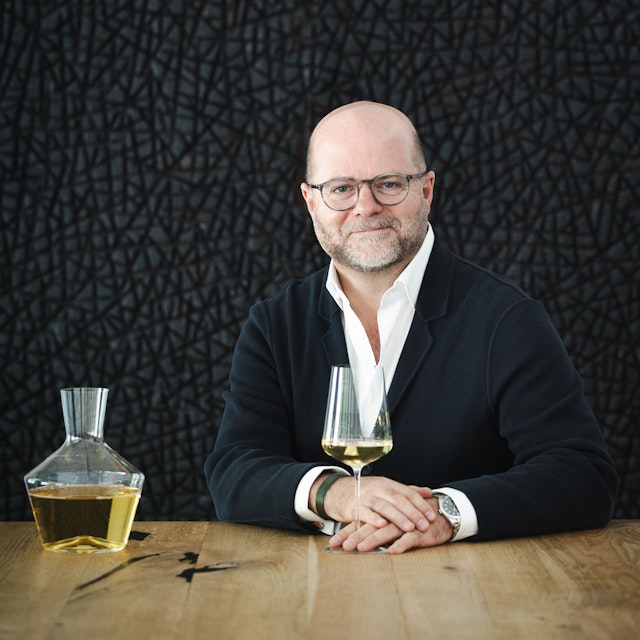
Weinberg Arlberg is not meant to be a festival
Clemens, how did the idea for Weinberg Arlberg come about?
A wine and culinary format at the start of the winter season in Lech has existed in various forms for a long time. The idea was not new. What was often missing, however, was continuity and perhaps also a clear substantive position.
I took up the subject some time ago because I was convinced that Lech had the potential for a format that reaches well beyond a classical gourmet or wine festival. My ambition was always to develop something that on the one hand meets the international quality level of the village, and on the other hand can only work here on the Arlberg: closely interwoven with the surroundings, the winter, the skiing, and the particular culture of the village.
Lech is a place with an exceptional tradition of hospitality. Over decades, a culture has developed here that combines international quality with a certain self-evidence. At the same time, the heart of Lech's beauty is not luxury or staging, but nature, and how respectfully people here engage with it. This connection of internationality, quality, hospitality, and alpine culture has always fascinated me. Weinberg Arlberg connects directly to this.
Why wine and cuisine, specifically?
For me, wine is far more than a product. Great wines always tell stories about origin, time, landscape, and people. For this reason, I am interested in wine above all as a cultural product.
And Lech is a remarkably fitting place for this. Many underestimate how centrally the Arlberg is actually situated between the great European wine regions. Bordeaux, Burgundy, Champagne, Northern Italy, the Rhône, Austria, or Germany: much is closer than one might think. At the same time, Lech has an exceptional density of outstanding hosts, restaurants, and wine cellars. This connection of alpine life and international wine culture is rather distinctive.
Weinberg Arlberg is run by an association. Why was this structure important to you?
Because an association has no owner. That was important to me from the start. Weinberg Arlberg should not belong to a person or a company, but should be carried by the village and its hosts. The businesses decide together on the development and direction of the project.
At the same time, it was important to us not only to involve hotels and restaurants, but to think of the region as a whole. The most important wine merchants of the region support the association, as do the tourism organisation and selected regional partners. This creates a network that reaches well beyond individual events and connects different parts of the value chain.
In the end, a format like Weinberg Arlberg only works in the long term if it is not thought of in isolation, but as a shared project of the village and its surroundings.
What distinguishes Weinberg Arlberg from classical wine festivals or trade fairs?
We deliberately do not want to be a fair, nor the next gourmet festival. Of course, this is about great wines and exceptional cuisine. But content, conversations, and personal encounters are just as important. For this reason, alongside the tastings, there are discussions on subjects that currently occupy the wine world.
And perhaps still more important: the structure of Lech changes a great deal. The distances are short, the events are deliberately small. As a result, encounters arise often as a matter of course, at breakfast, at the bar, or after a tasting. It is precisely these chance conversations that make Weinberg Arlberg particular for me.
What is the long-term vision behind the project?
In very practical terms: I hope that at some point at the beginning of December, no one from the international wine world has time for other appointments because everyone wants to come to Lech. But not for reasons of size or staging. Rather because something emerges here that is hard to find elsewhere: great wines, outstanding hosts, demanding cuisine, compelling people, and at the same time this particular atmosphere of the Arlberg at the start of winter.
In strategic terms, this is about more than an event week. I hope that Weinberg Arlberg becomes, in the long term, a place where people from the wine world genuinely enjoy coming together, exchanging, and developing new ideas together.
It is precisely from such encounters that the most compelling things often emerge: new business relationships, joint projects, discussions about the future of the industry, or initiatives that can have an impact far beyond the Arlberg. Weinberg Arlberg is therefore not only a stage for enjoyment, but also a platform for exchange, debate, and further development.
In the long term, we also want to extend this idea beyond the actual week, for example through the Weinclub Arlberg as a community and network that connects guests, producers, sommeliers, merchants, and wine enthusiasts.
At its core, the question is always the same: how can wine, as a product of enjoyment and culture, bring people together, inspire, and trigger relevant conversations? If Weinberg Arlberg becomes a credible place for this, that would probably be the finest development.