
Austria's role in the world of Chardonnay & Sauvignon Blanc

Austrians are justly proud of their white wines but how are they perceived on the international stage? Are international varieties such as Chardonnay and Sauvignon Blanc associated with Austria at all?
Moderator Willi Klinger put these questions to three international experts from as part of the Arlberg Weinberg 2024 conference in Lech.
Patrick Schmitt MW , Editor-in-Chief of The Drinks Business, the leading news magazine for the wine industry, with a daily newsletter of 32,000 subscribers worldwide and a monthly print magazine (15,000 circulation), brought soberinganswers from the UK, where one in three bottles is labelled ‘Sauvignon Blanc’ and sold at an average price of just under £7. New Zealand sets the stylistic benchmark in the UK.
South Africa and Chile also have large market shares. Austria only appears in the import statistics as a distant second. This is not surprising, because of the 150,000 hectares of Sauvignon vineyards worldwide, only 1,700 hectares are in Austria. Half of these are in Styria alone and Styrian Sauvignons are so successful in the domestic market that only a few bottles cross the country's borders.
Cokie Ponikvar , a hugely successful 23-year-old wine blogger (CokiesWorldofWine) from Canada, whose informative, fast-paced videos are followed by more than 470,000 mainly young consumers from all over the world, had never tasted Austrian wines before she was invited to the Austrian wine fair VieVinum in summer 2024.
Although Canada is regarded as a very important export market by Austria (export value has increased sevenfold in the past five years), this does not mean that Canadians are actually aware of Austrian wines, as Cokie bluntly admitted.
Aleks Zecevic , who reports on Central European wines for the US magazine Wine Enthusiast and spends a lot of time in New York, took a completely different view. “Most of the restaurants that have opened in New York in the last 15 years have Styrian wines on the menu.” Grüner Veltliner is even more common, but there is significantly more of that variety, with around 15,000 hectares in Austria planted to GV.
“ Grüner Veltliner is only my fourth favourite variety from Austria ,’ says Zecevic, “ after Sauvignon, Chardonnay and Riesling. ”

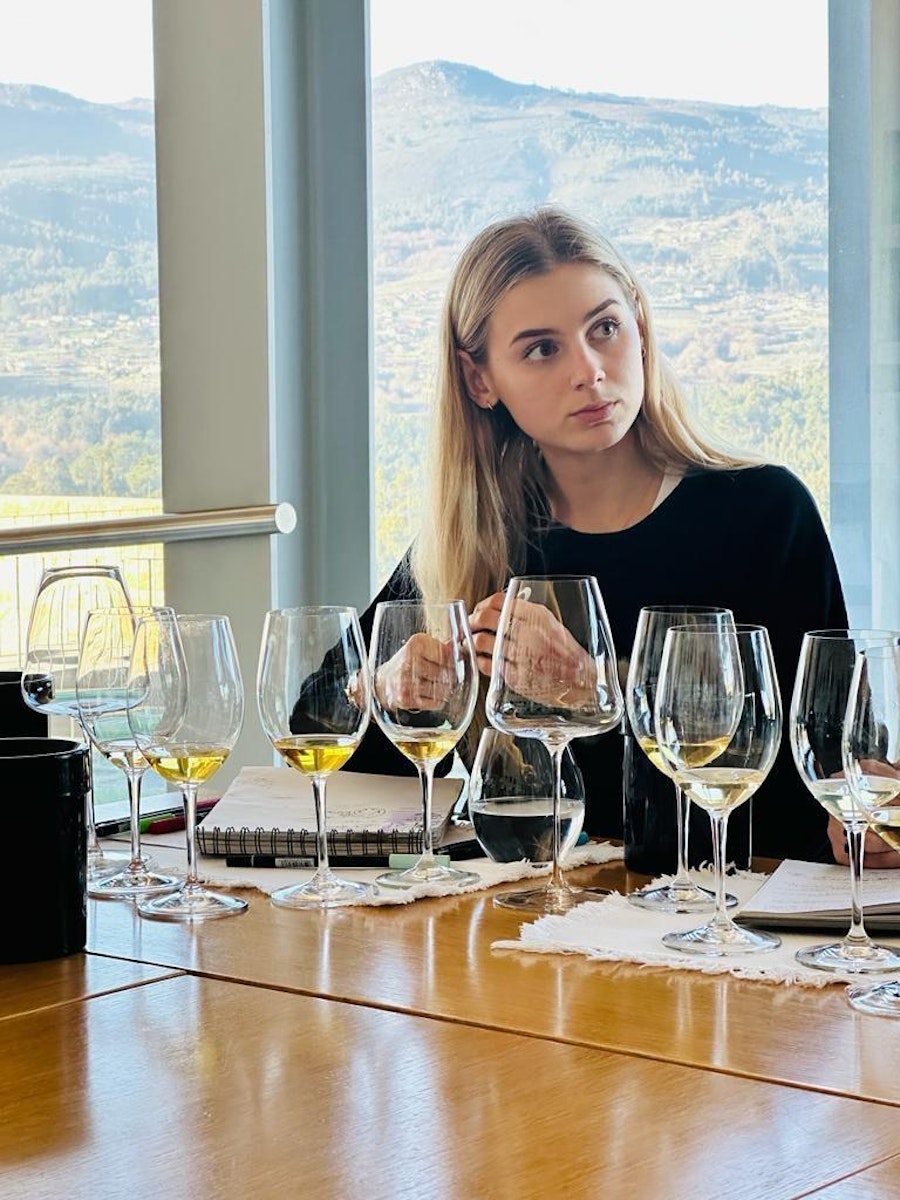

Chardonnay: every country’s darling
Chardonnay is the most important white wine variety in the world. Of the seven million hectares total of vineyards worldwide, 30 percent, or a good 220,000 hectares, are planted with Chardonnay. Chardonnay can be found from Australia and Argentina to Armenia and the styles are diverse because this variety is capable of such a broad range of expression.
How much is Chardonnay worth to the English? Only just over £6 is the average price paid for Chardonnay, Schmitt revealed. Exceptions are Champagne and Burgundy and the rapidly growing proportion of English wines, where a Chardonnay from Essex can fetch £40.
At the Global Masters, a competition organised by The Drinks Business for premium wines from all over the world, four categories of Chardonnay were identified. The entry-level range (up to £20) is the most competitive and this is where wine lovers get really good, reliable wines, often with freshness, varietal characteristics and precision.
In the £20 to £30 price range, there was disappointment in many respects from the critics. The wines did not live up to the price promised. The best wines, on the other hand, were in the £30 to £50 range. Not cheap, but really delicious.
The highest-rated wines are characterised by ripe fruit, good and elegant use of wood, a little yeast, hints of butter and brioche, good texture and length. Full-bodied, yellow-fruited, rather generous wines are therefore back in fashion. ‘Skinny’ models, which show more structure than body, are apparently again being penalised by the judges.
Austrians are winners at the Global Masters
The ‘Master’ – the highest rating in the varietal category from all over the world – was awarded in 2024 to Chardonnay Ried Katterstein from the 2021 vintage from Kollwentz winery, which costs between £50 and £70 in the UK.
Two years before, an Austrian Chardonnay also won this title: the 2018 Ried Grubthal from Reinhold Muster in Gamlitz (£50). In the ‘Unoaked Sauvignon’ category, the 2019 Ried Neusetzberg from the Krispel winery was chosen as a champion. In 2024, the Sauvignon Ried Kranachberg from Hannes Sabathi was a top scorer.

Why so unknown?
So, Austria's Chardonnays and Sauvignons are successful in competitions and yet lack visibility on the international market. Why is that? One factor is the overall low volume of
Austrian production. Another is the names and labelling of the wines. When Chardonnays from Styria are marketed under the name Morillon, for example, the vast majority of international consumers do not realise it is synonymous with Chardonnay.
Willi Klinger also noted that the boom in Styrian wines was, until recently, mainly evident in German-speaking countries. While Austria's Grüner Veltliner, Riesling and sweet wines gained a foothold in the USA in the 1990s, Styrians were initially unable to score points there despite having good importers. The perception was that they were too expensive as varietal wines and too unknown as terroir wines.
Increased interest was not seen until the Sauvignon Blanc congress in Styria in 2008 and successful participation in international competitions like the Concours Mondial du Sauvignon Blanc. Styrian Sauvignons and Chardonnays have also received high ratings from international critics (especially on robertparker.com).

Gruner - and was there anything else?
Of course, Austria has also positioned itself very successfully for many decades as a Grüner Veltliner country and has a relative monopoly on this variety. A turning point was not reached until 2008, when the first worldwide Sauvignon Blanc congress was held in Styria and the question as to whether Sauvignon Blanc is one of the world's great grape varieties was addressed. A tasting which subsequently took place in New Zealand, also dealt with the stylistics and recognisability of Sauvignon Blanc.
The wines with intense, aromatic tropical fruit were clearly located in Marlborough (NZ), while the wines from the Loire showed an unmistakable linear, mineral style. The Styrian Sauvignons, on the other hand, were characterized by a yellow-fruity style with good freshness – the best of both worlds.


This is just the beginning
Thus, it was only at the beginning of the 2000s that Sauvignons from Styria made their first appearance on the fine wine stage. They do not yet have a truly permanent place there, even though the acreage in Styria has doubled since then. What is missing is awareness.
Patrick Schmitt MW , for example, recommended a listing on the Place de Bordeaux to secure a position in the canon of the world's great wines. Austria is – with the exception of the sweet wines from Kracher winery – not represented on the Place.
Another suggestion from Schmitt: a blind tasting of the most renowned Sauvignon wines and blends in the world, including the likes of Haut-Brion, Screaming Eagle and Ornellaia. Above all, however, it seems important to Schmitt to create a comprehensive archive. “The greatness of a wine lies in the fact that it gets better and better over the years. You have to be able to prove that.”
More than one variety: Styrian terroir
Aleks Zecevic revealed himself to be a big fan of Styrian wines. “ While other regions such as California or Burgenland have planted Chardonnay to make wines like in Burgundy, Chardonnay vines have been growing in Styria for generations – only the winegrowers didn't know that it was Chardonnay. Styria developed its very own style of origin: wines that express their sites and their soils and are not orientated towards other regions. Chardonnay is one of the greatest varieties in the world because it reflects the origin of the wines. ”
And in Styria, Sauvignon is also much less superficially aromatic, but more characterised by the vineyards. This is also important, because Styria has extreme conditions: incredibly steep vineyards and it is one of the rainiest regions in Europe. Therefore, it also seems important to put the origin – the region, the locations – in the foreground. That’s because unlike the name of the variety, the origin is not interchangeable. High-quality wines are always marketed on their origin, not on the variety.
Social media, please!
Here Cokie Ponikvar spoke again: “Why don't you show how you work? You are in these incredible steep slopes every day, take the young generation there with you, show videos of your heroic work. If the wines are not known, it is not because of the quality, because it is incredibly large. It's because you're not communicating well. That starts with language – how can the world follow you if you don't post in English?
“Don't say youth are not interested in wine. The opposite is the case – but you have to tell your story on social media, that people all over the world share in your world. In the monopoly shops in Canada there is little advice, whereas social media helps to tell the story of origin and work. And the sommeliers are so important, but how can they tell you something about your wines if you don't give them a chance to experience these things.”
Newsletter
Subscribe and never miss an event!