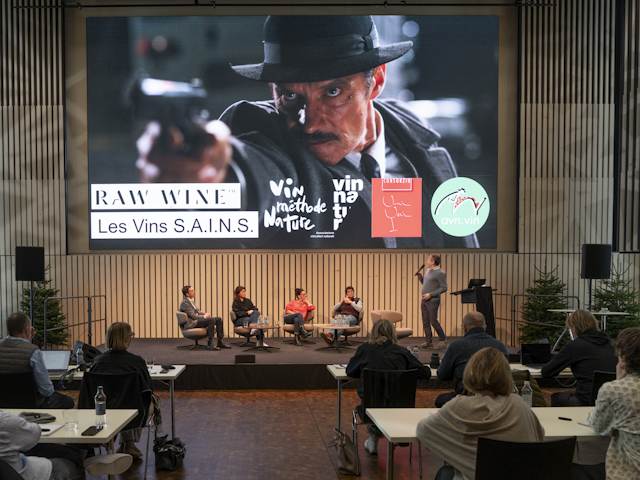
Two different paths – same goal?
What appears to be a conflict in the wine world today began (as is so often the case with conflicts) with a linguistic inaccuracy. Simon J. Woolf, the author of successful books such as ‘Amber Revolution’ and ‘Foot Trodden’, explained this in his introduction to the discussion on Terroir & Natural Wines , which took place on 12 December 2024 as part of the Arlberg Weinberg symposium in Austria. So, the etymological history of the origin of the term ‘natural wines’, which many people take offence at today:
The desire to change viticulture arose in Beaujolais, a French region that initially become very successful in the second half of the 20th century but subsequently degenerated into an uninteresting industrial wine-growing region due to overproduction, with herbicides used to reduce time-consuming mechanical work, artificial fertilisers to force the vines to produce high yields, sugar added to compensate for a lack of ripeness and industrial yeast being used to ferment the juice.
“There is less life in these soils here than in the Sahara,” complained the famous soil researcher Claude Bourguignon in the 1980s. Breaking out of this vicious circle was the aim of personalities such as Jules Chavet and Jacques Néauport, two pioneers of a new movement that championed the production of wines without additives.
They used the same term for their wines as for yoghurt, which contains no fruit, no sugar and no flavourings and is called ‘Yaourt Nature’ in French.
Therefore: Vins Nature.
The new era began in the 1990s with a few producers and small wine bars in Paris that offered Vins Nature or Vins Sans Soufre . Wines without additives, without chemicals, without intervention.
The movement continued to spread, and when it spilled across the English Channel to the UK, an English term for Vins Nature was needed. Analogous to yoghurt, it might have been Plain Wines or Wines with Nothing Added or Pure Wines . But in no time at all, it became Natural Wines and that suddenly sounded completely different.
Today, the movement is huge and spans the entire world. An incredible development. One person who has made a significant contribution to the success of Vins Nature is Isabelle Legeron MW . She was the first French woman to be earn the Master of Wine title, before founding an event format for artisanal natural wines under the name RAW. RAW WINE fairs now take place in New York, Los Angeles, Montréal, Toronto, Berlin, Paris, Verona, Copenhagen, Tokyo and Shanghai. And everywhere there are thousands of consumers, mostly young people, who are interested in wines that are as natural as possible.
The first RAW WINE took place in 2012. It was initially a difficult endeavour, says Isabelle Legeron MW. “But the golden era began in 2017. Importers suddenly couldn't get enough, and neither could consumers. And we're only talking about a period of 12 to 14 years.” An incredible success story – so what does the future hold?
“I think it's like any growth. Slow and arduous at first, and then it takes off, because suddenly everyone wants to be a part of it. And Covid has changed the whole world anyway. People are paying even more attention to their health now than they used to, and wine has become even more complicated to sell than it already was,” says Legeron.
What is important to Legeron when she selects wines for RAW? “They definitely have to be terroir wines, so they have to authentically show their origin, concentration, definition, structure and texture. Honest wines that don't necessarily want to be top scorers.”
This makes Legeron's claim fundamentally different from the prestige wines of the 1990s and 2000s: strong, powerful, often heavy with a lot of new wood, weighty bottles and high prices. These were the wine icons that aimed for – and received – the highest ratings and are now hoarded by collectors at astronomical prices.
However, Legeron also sees the danger of commercialisation: “More and more particularly drinkable wines are coming onto the market under the title ‘naturals’. With low alcohol and low concentration, they are often called ‘glou-glou’ wines. And lots of Pet Nat (Pétillant Naturels) are being sent to me. To be honest, I don't even taste them.”

Simple & glou-glou
Some producers try to avoid full ripeness by harvesting particularly early or achieve an easy drinkability with a maceration period at particularly cool temperatures. With this type of wine, they are courting a young, inexperienced audience. But they are saying goodbye to genuine terroir expression. The wines become simple.
Simplification: that is what the market wants. But wine is a demanding commodity. In its production as well as in its ageing and understanding.
Don‘t mix it up
Simon J. Woolf tries to categorise the various terms used in the natural wine scene: Orange Wine, for example – which should not be confused or even equated with Natural.
“Orange is not a style, but rather a vinification technique.” Pressing grapes straight away produces white wine. With black grapes, rosé or red wine is produced depending on the time spent on the skins. White grapes produce white or orange wine, depending on how long they are left on the skins. So, there are four wine colours: white, orange, rosé and red.
However, the production of Natural Wines or Vins Nature covers a much broader spectrum than just the maceration time. One of their most important features is the use of no or very little sulphur, which acts as an antioxidant to ensure the longevity of the wine.

Funky wines
Natural wines face many misconceptions. They are said to be prone to oxidation, recognised by their volatile acidity, heavy on the Brettanomyces and ‘mousey’. They are described as fragile, incapable of maturing well and all tasting the same.
“If you want to work with minimal sulphur, it requires a lot of skill, experience and knowledge,” admits Woolf. Good natural wines are a question of balance. They don't happen on their own, but are the product of experienced and talented winemakers.
This is confirmed by Katharina Wechsler . The newcomer winemaker from Germany’s Rheinhessen only started making wine in 2010, initially focussing on the terroir expression of her home region, where mainly Riesling and Pinot Noir grow on limestone soils. One day she tasted a Matassa from Tom Lubbe's winery in the south of France, which is a pioneer of the natural wine scene, and it was an awakening experience. “This special texture: I had never tasted anything like it before, I was fascinated. I wanted to do that too.”
With the 2014 vintage, Katharina Wechsler experimented with maceration for the first time and gradually developed a second wine line, which she now calls Cloudy Wines. Although she is continuing her line of wines of origin, she says: “A lot of knowledge is incorporated into the classic wines. My way of vinification has changed.”

Tradition is not the same as terroir
Sara Pérez can tell of a similar evolution. The Spaniard, who studied biology and philosophy before starting to work at her father's Mas Martinet winery in the 1990s, remembers: “In 1994, the Caymus team came to visit us and we tasted the wines from this Californian winery together. It was a shock for me: their wines tasted so similar to ours. The same thing happened to me with Australian wines. What is it about Priorat if these wines from other parts of the world taste almost the same?”
Perez’s search for terroir began. And in doing so, she had to say goodbye to the term ‘tradition’. ‘Real’ Priorat wines had 16 to 17% alcohol. “That was called typical - but it wasn't an expression of terroir.”
Perez entered a new era – and not just in winemaking. She also said goodbye to other conventional rules. She took her older children out of public school and delivered her next baby at home. She reset everything and began to rethink her entire understanding of the world.
In another lecture at Arlberg Weinberg, which focused on water shortages and the challenge for vines, she talked about the drama of the hot, dry years and how she manages to vinify wines of incredible elegance and light-footedness on the glowing slate terraces of Priorat.
And yet at the time, the opinion was: “If you want to express this region in a different way, then it's simply not Priorat wines.”
Andreas Wickhoff MW also had to deal with this big question of whether a ‘new’, unfamiliar style can still stand for an appellation. As the managing director of the very successful Austrian export association Premium Estates of Austria, he suddenly had completely new wine styles in his portfolio from 2007 onwards. Two of the most prominent wineries, Fred Loimer and Gernot Heinrich, are also founding members of the Respekt group. They had committed themselves to biodynamics and their changed approach in the cellar meant their wines showed themselves as significantly different from previous vintages.

“It was a learning process - for me, for the winemakers and for customers all over the world. And I often asked myself whether and how I could position the wines correctly,” recalls Wickhoff of the change in style of some of his group’s producers. “I liked the wines myself – but it was difficult to find the right distribution partners for them.” It takes time to go from an extremely enthusiastic ideal to a refined style that is accepted and recognised by the market. The development process takes place on both the producer and customer side.
“Blaufränkisch from Leithaberg has developed into a wonderfully terroir-driven wine with a very purist expression under biodynamic cultivation,” says Wickhoff, who has been general manager of Bründlmayer winery since 2016 and only took on this job on the promise that the winery would go organic.
In the subsequent discussion with the audience, the criticism that ‘natural’ has degenerated into a marketing tool was repeatedly raised. PetNat and GlouGlou wines are commercially very successful, but with their simplification they have almost perverted the origin of Vins Nature.
“And what does that have to do with terroir if the vineyards are sprayed with pesticides and if water is pumped into the vineyard from outside for irrigation?” came the immediate counterargument.
“A lot of what comes onto the market as natural wine has no origin character,” says Wojciech Bońkowski MW from Poland, who can still remember his Master of Wine exam in which he had to recognise the origin of wines in a blind tasting. “If I had five naturals in front of me, I wouldn't be able to recognise any appellation, they all taste the same.” Where is the pleasure in the wine scene?
“If the wine simply tastes really good,” Simon J. Woolf replied, “is it so important to categorise its origin?”
Typical Rioja
Very often, ‘origin’ can be recognised by the style of vinification. For example, if you put 12 Sauvignons from different regions of the world on the table, you would recognise the assignment to the regions more by the typical processing and vinification methods, not so much by the ‘terroir’. A wonderful example is the blind tasting in the sommelier competition, where a candidate was faced with a range of red wines. He quickly defined Rioja. He recognised it by the scent of American oak.

Critically scrutinise
Jamie Goode , one of the most respected scientific wine writers, spoke up from his seat in the audience at the conference: “Just because certain agents are allowed doesn't mean they are being used. The slide that Simon Woolf showed implies that wineries that don't call themselves natural use all these things. But that is simply wrong. Not just because of the high cost involved. Most of the world's fine wines are absolutely natural wines, because they use little or none of the products mentioned and very little sulphur.”
“Furthermore,” Jamie Goode countered , “we are discussing an outdated division of viticulture into conventional, sustainable and biodynamic/organic. Even though I'm a big fan of organic and biodynamic wines, we have to admit that they often don't come from the most sustainable farming methods.”
Vines just are not resistant to fungal diseases, and especially in regions where rainfall is demonstrably increasing during the growing season, vines can only be protected with products containing copper. As these contact agents (unlike systemic products) are washed off after every rainfall, they have to be applied again and again. Ten to 15 sprays per season cannot be described as sustainable. Also, the fact that the soil is repeatedly torn up during mechanical weed control leads to dehydration and impairs the build-up of organic matter in the soil. For Goode, all of these are reasons why he considers regenerative approaches to be more effective.
“What counts is biodiversity, healthy soil and resilient vines. Dare we say that in some cases a targeted use of systemic fungicides or perhaps a herbicide spraying at the beginning of the season could help to keep the soil and plants healthier and lead to fewer interventions during the course of vegetation?”
Jamie Goode continues: “I think that this division into ‘natural versus conventional’ is not helpful. We should look at this as developments that should bring us more together as a wine community and not divide us into opposing groups. And in any case, it is to the detriment of the whole industry if some people talk badly about others.”
This statement coincided with Simon J. Woolf's closing words: Natural wine should not be a style, but a philosophy. And the aggressive tone should disappear: “This is not a battle between two camps, but a joint development. We should not compartmentalise but learn from each other.”

Newsletter
Subscribe and never miss an event!